

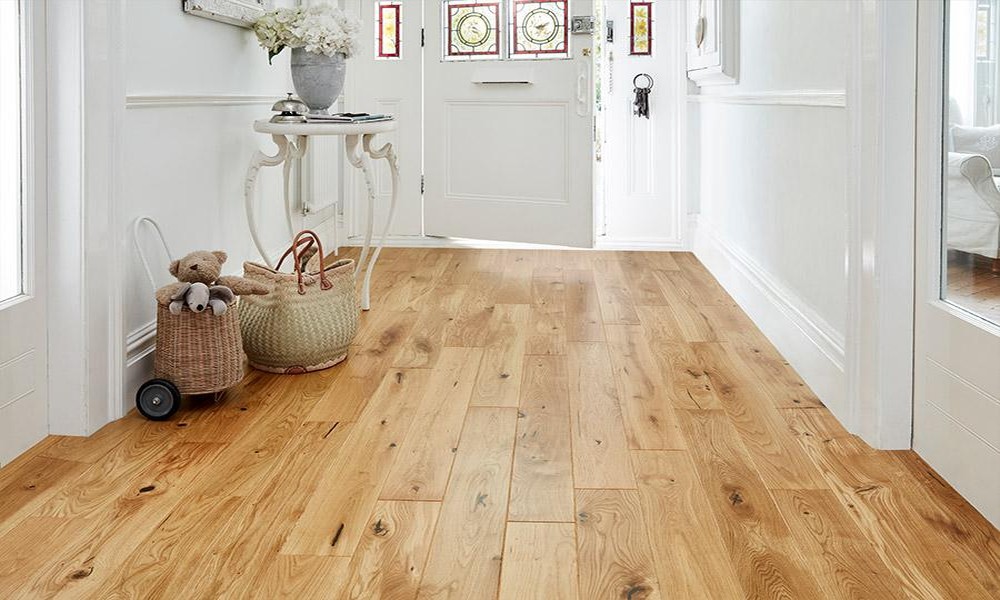
Engineered oak flooring has moved from a niche alternative to the dominant choice for new oak floor installations in UK homes over the past decade. Its rise has been driven not by marketing but by genuine practical advantages over solid oak in the conditions most commonly encountered in British residential and commercial settings.
For homeowners and specifiers approaching an oak flooring decision for the first time, understanding what engineered oak is and why it performs the way it does makes the choice considerably more straightforward.
What Engineered Oak Flooring Is
Engineered oak flooring uses a real oak wear layer bonded to a stable multi-ply or hardwood core. The wear layer is real timber, carrying the same grain, colour, and natural variation as a solid oak board. The core provides the structural stability that distinguishes engineered from solid: rather than a single piece of timber throughout its thickness, the board is built up from cross directional layers that resist the expansion and contraction solid wood undergoes in response to changes in temperature and humidity.
The result is a floor that looks and feels like real oak because the surface is real oak, but that behaves considerably more predictably in variable environments. This dimensional stability is the defining practical advantage of engineered oak over solid, and it directly determines where and how each product can be used. A comprehensive range of engineered oak flooring is available from UK specialists across a wide selection of widths, grades, and finishes to suit all project types.
Why Stability Matters in UK Homes
The UK climate produces moderate but consistent humidity variation through the year, and modern homes with central heating create particularly challenging conditions for solid timber flooring. As indoor humidity rises and falls with the seasons, solid oak expands and contracts across its width. In a well controlled environment with stable humidity, this movement is manageable. In real homes with variable heating patterns, kitchens, extensions with large areas of glazing, and rooms over concrete subfloors, the movement in solid oak can be significant enough to cause gapping in winter and compression in summer.
Engineered oak handles these conditions far more reliably. Its cross ply construction dramatically reduces the magnitude of seasonal movement, which is why it is the preferred specification for kitchen flooring, ground floor rooms on concrete subfloors, and any installation over an underfloor heating system where the thermal cycling creates conditions that solid oak is poorly suited to.
Underfloor Heating Compatibility
Underfloor heating has become standard in many new UK builds and renovations, and it creates a particular challenge for flooring materials. As the floor surface heats and cools during daily operation, any flooring material above it is subjected to repeated thermal cycling that drives expansion and contraction. Solid oak is generally not recommended over underfloor heating for this reason. Engineered oak, with its stable construction, is compatible with most underfloor heating systems provided the surface temperature does not exceed the manufacturer’s specified maximum, typically around 27 degrees Celsius.
Wear Layer Thickness and Longevity
One of the most important specifications to confirm when selecting engineered oak is the wear layer thickness. The wear layer is the real oak surface that can be sanded and refinished as the floor ages. Thicker wear layers allow more sanding cycles and therefore a longer overall floor life. Wear layers below 3mm allow little or no sanding and should be treated as a non-refurbishable product. Wear layers of 4mm to 6mm allow one or two light sanding cycles. Layers of 6mm and above allow more extensive refinishing and represent the more durable end of the engineered market.
Board Width and Grade
Wider boards suit larger rooms and produce a more contemporary aesthetic with fewer visible joints across the floor. Narrower boards are more appropriate in smaller rooms and period properties. Oak grade determines the visual character: prime grade offers clean, consistent grain with minimal knots, while rustic or character grade features natural knots, colour variation, and the markings that give oak its distinctive character. Neither is objectively superior; the right choice depends on the interior style and personal preference.
Frequently Asked Questions
Is engineered oak as durable as solid oak?
In most practical applications yes; engineered oak with a quality wear layer performs equally well underfoot and, in variable humidity or underfloor heating environments, often outperforms solid oak because it is less prone to movement related problems.
Can engineered oak be installed over concrete?
Yes, engineered oak is suitable for installation over concrete subfloors as a floating floor or glue down installation, provided the concrete is dry, flat, and within the moisture content tolerance specified by the manufacturer.
How do I know if my underfloor heating system is compatible with engineered oak?
Confirm the maximum surface temperature of the system does not exceed the flooring manufacturer’s specified limit, typically 27 degrees Celsius, and that the system can be set to heat and cool gradually rather than cycling rapidly.
Can engineered oak be installed in a kitchen?
Yes, engineered oak is considerably better suited to kitchen environments than solid oak due to its greater resistance to moisture related movement, though standing water should still be cleaned up promptly and the floor should not be installed in areas of direct regular water exposure.
Final Thoughts
Engineered oak flooring has earned its dominant market position through genuine performance advantages in the conditions UK homes actually present. Its dimensional stability, underfloor heating compatibility, and suitability for ground floor and concrete subfloor installations make it the more practical specification in the majority of residential projects.
For homeowners approaching an oak flooring decision, the full range of solid and engineered oak flooring and joinery from specialist UK suppliers offers the widest choice of widths, grades, and finishes to suit every project and budget.