

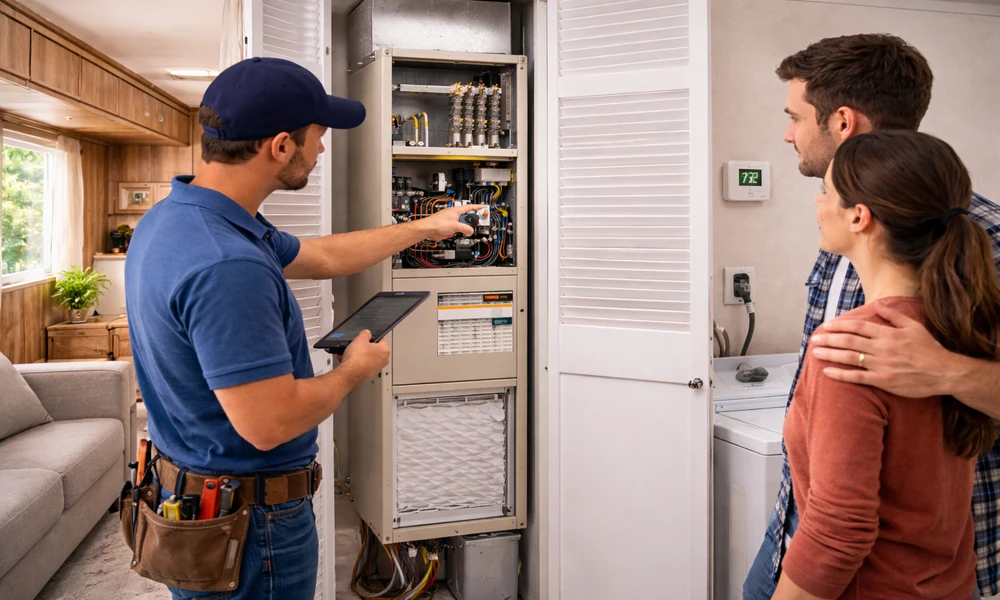
Open the hallway closet in a manufactured home and the furnace inside looks familiar enough. There’s a metal cabinet, a filter, and a thermostat wire running off somewhere. Plenty of owners assume it’s the same machine sitting in a basement two streets over, just shrunk down. That assumption leads to more wasted money and more unsafe repairs than almost anything else in mobile home heating.
Northwest Indiana winters make the difference matter even more. One January week can swing from slush to subzero, and both kinds of heating systems get pushed hard. JG Heating and Cooling LLC is a family-owned contractor in Portage that repairs and installs standard furnaces and boilers alongside units built for mobile homes. Seeing both kinds side by side shows how differently they behave once the cold sets in.
The two machines share a purpose but very little else. Here’s where they split apart.
Why the Warm Air Travels Down Instead of Up
In a typical Indiana house, the furnace sits in the basement or a utility room and pushes heated air upward through ducts in the walls and ceilings. That’s called an upflow design, and it suits homes built on foundations.
A manufactured home has no basement. Its main supply duct runs lengthwise through the belly of the home, under the floor. So the furnace is usually a downflow unit, also called counterflow. It pulls air in at the top, heats it, and sends it straight down into that floor trunk line.
This one change ripples outward. When central air is added, the cooling coil sits below the furnace in a separate base box instead of on top. The registers are on the floor along the length of the home rather than spread out room by room. A standard upflow furnace simply can’t be flipped over and used in its place.
The Sealed Box Rule Behind Every Mobile Home Unit
The biggest difference is safety, not airflow. Manufactured homes are smaller and tighter than most site-built houses, so a combustion problem can build up much faster in a small space.
Federal construction standards address this directly. Under HUD’s manufactured home installation rules, fuel-burning appliances such as furnaces have to keep their combustion system completely separate from the air people breathe inside the home. In practice, that means a sealed combustion furnace. It draws its burner air from outside, usually through a roof jack or from beneath the home, and it vents exhaust back outside the same way.
Many house furnaces, especially older or lower efficiency models, pull combustion air from the room around them. Put one of those in a mobile home closet and you get exactly the setup the rule was written to prevent. Mobile home furnaces also carry a listing for manufactured home use. Installing an unlisted unit can cause trouble with inspections, insurance claims, and resale.
Where the Return Air Hides
Walk through a house and you’ll find return grilles pulling air back to the furnace through their own ductwork. Most mobile homes don’t have return ducts at all.
Instead, air finds its way back through louvered closet doors, gaps under interior doors, or a grille set into the furnace closet. This works fine until something blocks it. A dresser pushed against a louvered door, a closet used for storage, or a new solid door installed during a remodel can starve the furnace of air. When that happens, the heat exchanger runs hot, the limit switch trips, and the system starts cycling on and off in ways that look like a mechanical failure.
The filter is often behind that closet door too, sitting on top of the cabinet. It’s easy to forget, and in a system with this little return capacity, a clogged filter does more damage than it would in a basement furnace.
Ductwork You Can’t See Without Crawling Underneath
House ducts mostly sit inside heated space or in a basement. Mobile home ducts run through the belly, wrapped in a thin barrier board, with nothing but skirting between them and an Indiana February.
That exposure creates problems house owners rarely deal with. Watch for these signs, which usually point to trouble under the floor rather than inside the furnace:
- Registers at the far end of the home blowing weak or barely warm air
- One half of a double wide staying noticeably colder than the other
- Torn or sagging belly board visible from outside
- Dust, insulation bits, or a musty smell coming from the floor vents
In double wides, a flexible crossover duct links the two halves beneath the home. It can sag, tear, or get chewed by rodents, and when it fails, a whole section of the home goes cold while the furnace runs normally.
Smaller Machines With a Narrower Parts Shelf
Mobile home furnaces are sized for less square footage, so their heating capacity tends to be smaller than whole-house units. Only a handful of manufacturers build them, which means replacement blowers, igniters, and control boards aren’t always sitting on a supply house shelf next to standard parts.
Fuel matters too. Some communities run on natural gas, while others rely on propane, and a furnace often needs a conversion kit to switch between them. Electric furnaces are also common in older manufactured homes. They’re simpler but can be expensive to run during long cold stretches.
A technician who works on these units regularly knows which parts actually fit and which “universal” substitutes cause problems later.
How Lake Country Winters Test Each System
A basement furnace lives in a protected space. A mobile home furnace is protected too, but its supply air leaves the warm closet and travels through the coldest part of the structure before reaching the rooms. Heat loss along that run is real, and it gets worse when skirting is damaged or vents along the base are left open into winter.
High efficiency condensing models add another wrinkle. Their condensate drain lines often run beneath the home, where they can freeze solid on a bitter night and shut the furnace down. Heat tape and proper pipe routing prevent most of these calls. Heavy snow can also bury intake and exhaust openings, so anything vented low needs a quick check after a big lake effect storm.
Deciding Between Repair and Replacement
Both furnace types tend to last somewhere around 15 to 20 years with decent care, but the decision looks a bit different for each. With a mobile home unit, it’s worth asking a few direct questions before spending on a major repair:
- Is the replacement part still made, or would it be a salvaged or adapted component?
- Is the current furnace listed for manufactured home use and properly sealed?
- Is the ductwork under the floor in good enough shape to make a new furnace worth it?
- Would switching fuels or adding central air later change which unit makes sense now?
A new furnace connected to leaking belly ducts will still leave the home cold and the bills high. Sometimes the smartest spending starts under the home, not in the closet.
Before the First Real Cold Snap
A few minutes of attention in early fall can head off most midwinter breakdowns:
- Clear everything away from the furnace closet and its louvered door
- Replace the filter and note the size for next time
- Walk around the skirting and look for gaps, sagging belly board, or animal entry points
- Test the carbon monoxide alarm near the sleeping areas
- Look up at the roof jack and make sure nothing is blocking it
The cabinet in that hallway closet may look ordinary, but it’s a specialized machine built for a home with its own rules. Treat it like a basement furnace and it’ll let you down. Treat it as its own system and it can keep a manufactured home warm through many Indiana winters.